
Staying Close to the Work
On craft, humility, and remaining a student

There’s a particular kind of distance that forms the moment you begin speaking about a craft too confidently. The work shifts subtly away from your hands and towards your identity. Towards explanation. Towards performance.
I notice this tension more and more now, particularly online. Everywhere you look, there are teachers. Guides. Experts. Systems for creativity, systems for success, systems for selfhood. Entire ecosystems built around explaining how to become something. Content about making content. Advice about how to package experience into something useful, marketable, scalable.
Individually, I don’t question it. But collectively, it leaves me wondering what happens when everyone becomes a teacher before they have remained a student long enough (or perhaps more importantly, a student forever?)
Craft, in my experience, doesn’t reward certainty for very long.
The older I get, the less interested I become in expertise that arrives too neatly. Most meaningful creative work seems to emerge from the opposite condition entirely. From uncertainty. From repetition. From spending long periods of time inside something without fully understanding it yet.
I feel this most clearly when I spend too much time online. What once felt like a place to discover references or ideas has become increasingly flattened. Taste is categorised, explained, over-articulated. Beauty loses some of its mystery the moment it is endlessly decoded. Certain aesthetics circulate so aggressively that they stop feeling personal altogether.It creates the illusion that creativity is something you can consume your way towards.
Most things that have genuinely shaped me arrived much more slowly. Through proximity. Through returning to the same references over years. Through making things badly before making them well. Through sitting with discomfort long enough that something deeper eventually reveals itself.
Craft, in its truest form, happens privately. Behind closed doors. In repetition. In small adjustments that nobody else sees.
You make something. It doesn’t quite work. The proportions feel off. The piece loses something once it moves from sketch to material. You revisit it. You remake it. Sometimes you leave it alone for months before understanding what was missing in the first place. Sometimes it takes years.
There is no performance in that space. No immediate reward. No applause. Only attention. I think that attention is becoming increasingly rare.
There’s a distinction I keep returning to between knowing your craft and staying close to it. Knowing can easily become fixed. It can harden into identity, calcify into authority, into the comfort of believing you’ve arrived somewhere. Staying close feels entirely different. It requires openness. Humility. The willingness to accept that your understanding is always incomplete. I love staying in the mindset of the student, it keeps me in a perpetual state of wonder and excitement. I call it the effervescence in my stomach. I feel it when I walk into the Grand Bazaar, when I am working on bespoke orders… and just working on new designs in general.
Sometimes you are deeply connected to the work. Sometimes you lose your instincts entirely. Sometimes you make things that simply are not good enough. That too is part of it.
When I was developing my recent fine collection, I became very aware of how much of the process remains invisible once a collection enters the world. What people eventually encounter is the resolved version. The polished object. The campaign image. The final edit. What disappears are all the attempts that led nowhere.
The pieces that felt unresolved once worn on the body. The designs that looked compelling conceptually but lacked weight in material form. The proportions that needed adjusting repeatedly. The techniques that demanded far more refinement than I initially anticipated. And sometimes, despite months of work, a piece simply isn’t good enough to produce more of.
I realised recently that even when I share “behind the scenes”, I’m usually still sharing something that has already succeeded. Something that has already earned its place in the collection. The “failures”, so to speak, remain hidden.
Looking back, I’ve probably learnt more from those pieces than the resolved ones. Knowing when to let something go, when to revise it, when to admit that an idea hasn’t translated successfully, is inseparable from the craft itself. It’s a quieter discipline. One that doesn’t translate particularly well into content, but sits beneath every meaningful body of work.
The failures remain hidden. So too does the sheer amount of labour sitting quietly inside certain objects.
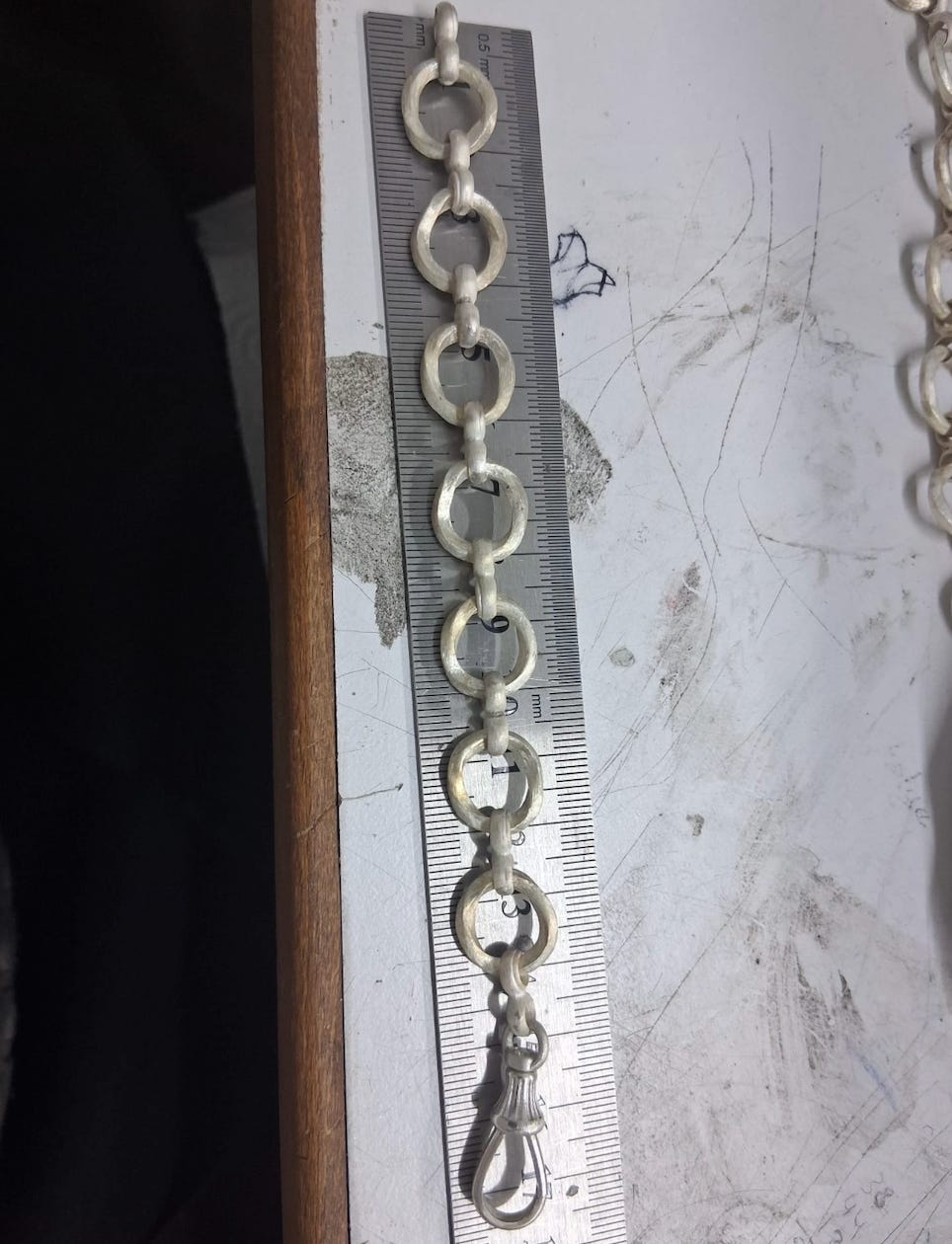
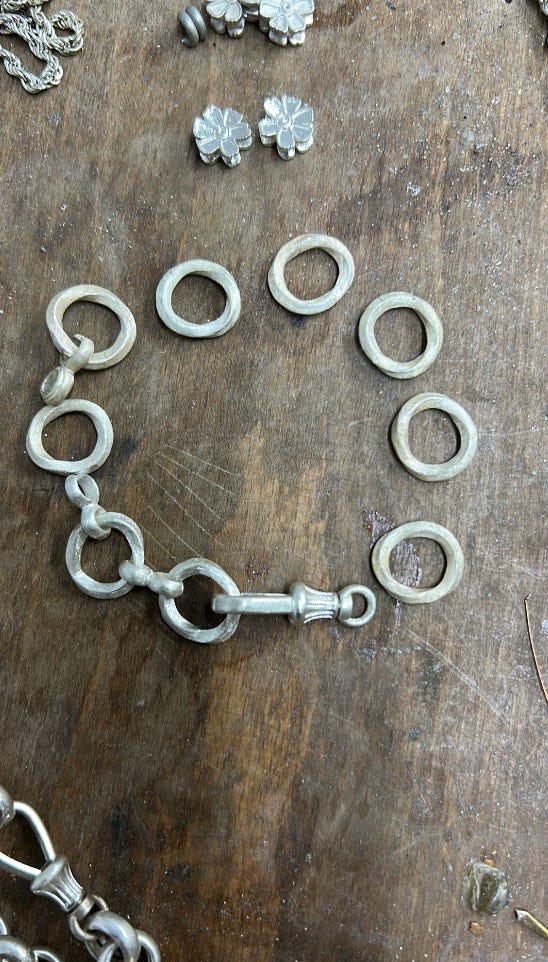
The Maillon chain, for example, was intentionally designed as a sculptural object rather than a standard production chain. Each individual link is first carved by hand in wax before being cast, assembled, and finished manually, making the process significantly more labour-intensive and far less scalable than a production-based chain.
The weight, proportions, and slight irregularities are all intentional. I wanted the chain to feel substantial, almost artefact-like, rather than commercially streamlined. Something closer to an object excavated than something optimised purely for production efficiency.
One chain alone takes multiple days to complete because of the level of hand involvement required at every stage.
And yet when someone encounters the final piece, none of that labour is immediately visible. What they experience is simply the feeling the object carries when worn. The density of it. The way it sits on the body. The subtle irregularity that makes it feel alive rather than mechanically perfect.
I think that’s true of most meaningful craft. The process disappears into the object itself.
A large part of this recent collection became an exercise in returning more deeply to research. Not just visual references, but historical context, ornamentation, symbolism, colour, and material language.
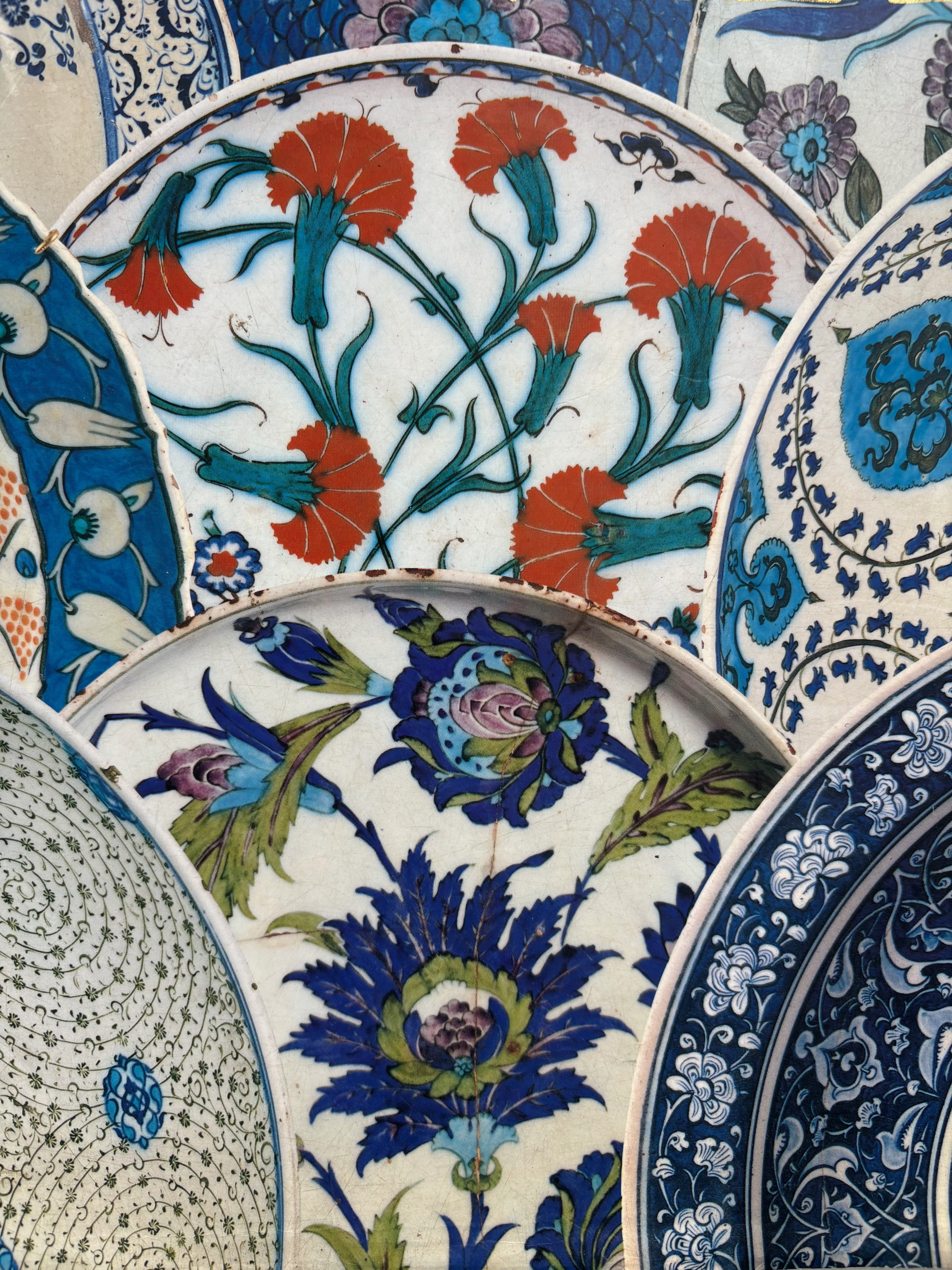
I spent long periods looking closely at Iznik ceramics and Ottoman decorative arts, particularly the way motifs move across mediums. The same floral forms appearing on tiles, manuscripts, textiles, architectural surfaces, and jewellery. Ornament wasn’t treated as separate disciplines. Everything existed in conversation with one another.
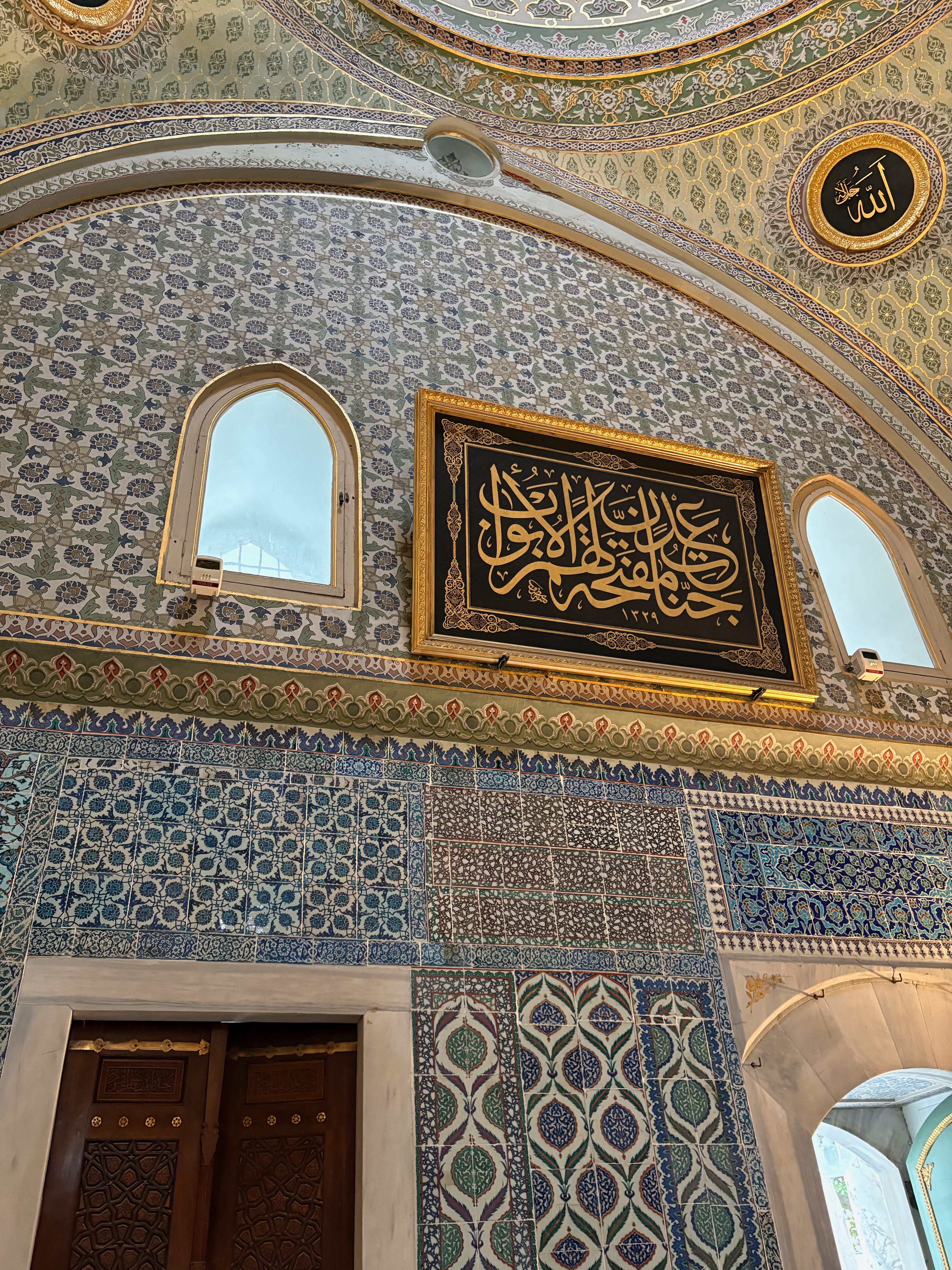
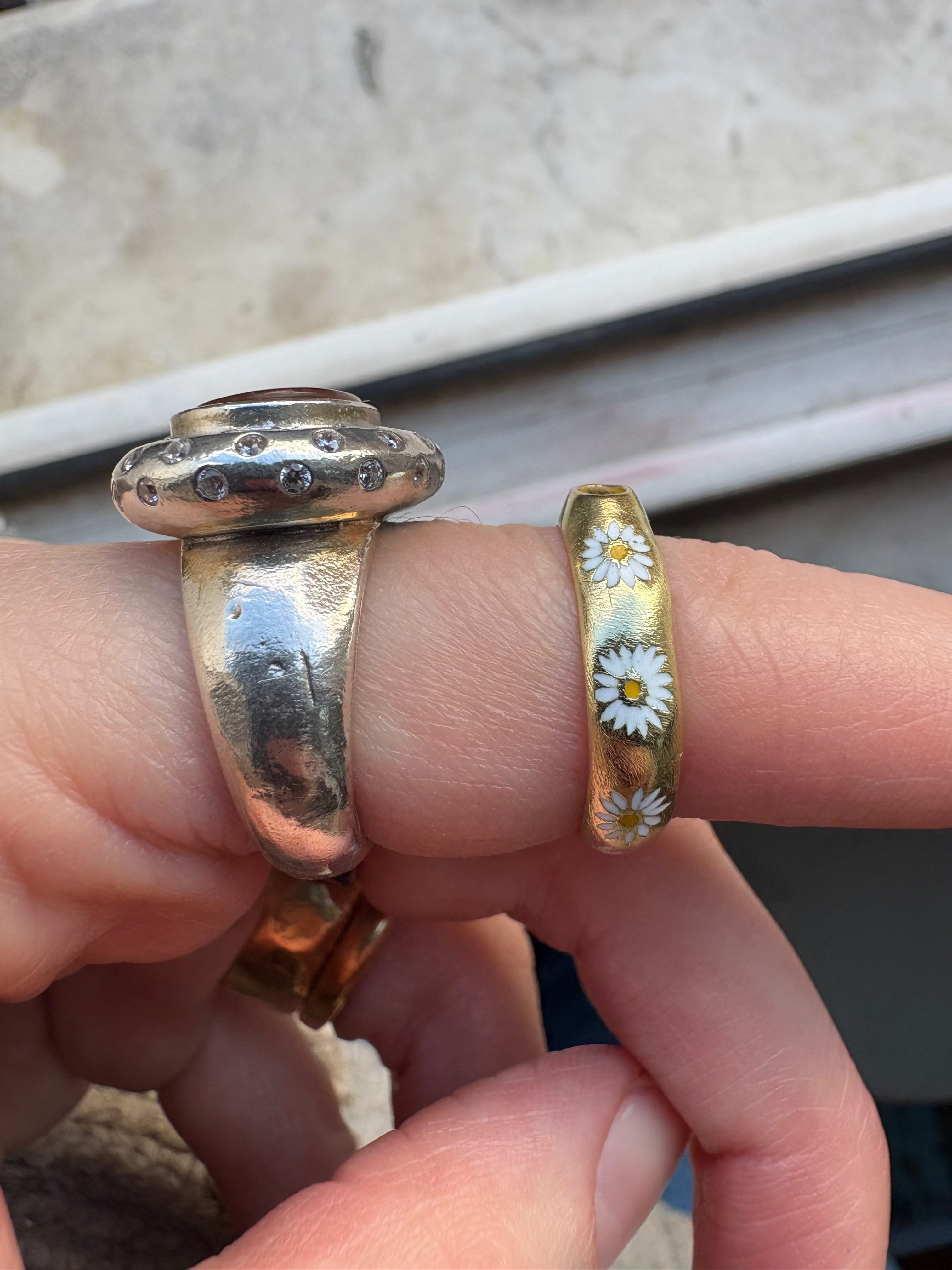
The enamel pieces in the collection take cues from papatya motifs, small daisy forms that appear repeatedly throughout Anatolian decorative traditions, alongside classic Iznik colourways of deep midnight blues, citrine yellows, oxidised reds, and ivory whites. I became interested in enamel not simply as decoration, but as a painterly element. A way of linking jewellery back to ornamentation, art, and the handmade. Some of the surfaces began feeling less like jewellery and more like fragments of miniature paintings translated into metal.
The karanfil, or carnation motif, became another recurring reference point. It appears constantly throughout Ottoman art and textiles and traditionally symbolised admiration, vitality, and devotion. I became fascinated by the elongated shape of the flower itself, the way it is stylised almost to the point of abstraction while still remaining unmistakably floral. There’s something incredibly restrained and elegant about it.
The lale, the tulip, carried a different emotional weight. During the Tulip Era of the Ottoman Empire, tulips became associated with refinement, pleasure, intellectual life, and beauty cultivated not as excess, but as part of daily existence. Even now in Turkey, to describe someone as living “in the Tulip Era” suggests a life of elegance and enjoyment.
What interested me most was how disciplined many of these motifs actually are when you study them closely. They are repeated carefully over centuries without losing their vitality. There is enormous refinement in their restraint. That taught me something while designing. Not every piece benefits from more. Sometimes the hardest thing is recognising when something is already complete.
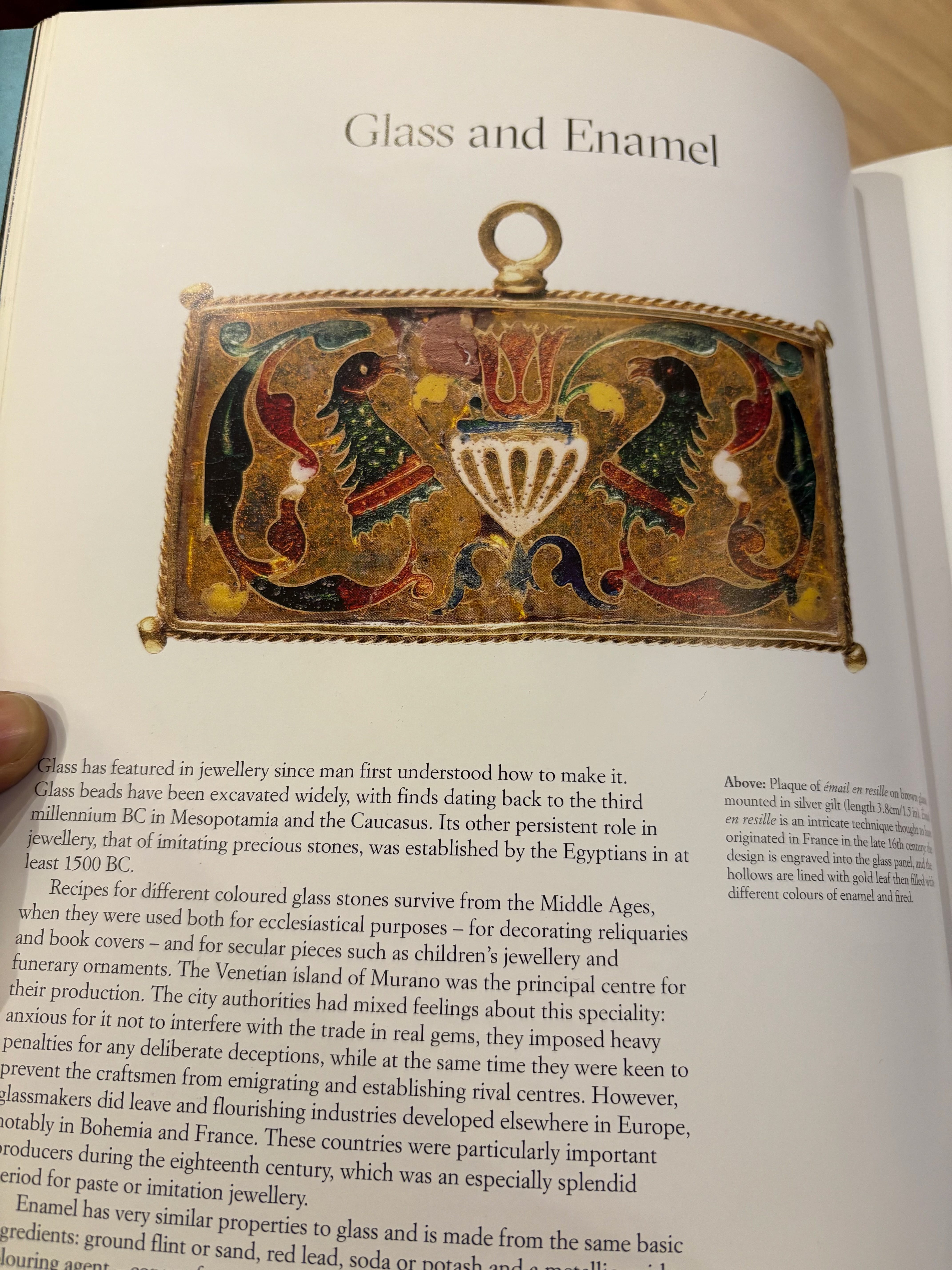
One of the areas that demanded the most patience in this collection was the enamel work itself. Hot enamel is an ancient process, and one that resists control at almost every stage. Finely ground glass pigment is applied onto the surface of the metal and fired repeatedly at extremely high temperatures until it fuses permanently to the piece. The colour shifts subtly in the kiln. Some tones deepen, others soften. Tiny variations in temperature, timing, or metal surface can completely alter the outcome.
It’s a process that requires surrender as much as precision.
Before any enamel is applied, each piece is first hand engraved directly into the metal. The engraved lines create the framework that holds the enamel in place, almost like drawing onto the surface before painting begins. I became increasingly interested in this stage of the process because it sits somewhere between jewellery and illustration. The metal carries the memory of the hand before colour ever enters it.
Watching the pieces move through the studios in Istanbul reminded me how layered traditional craftsmanship actually is. One person engraves. Another prepares the enamel pigments. Another fires the kiln. The final object carries many hands inside it.
Historically, enamel has moved across Byzantine jewellery, Persian decorative arts, Ottoman ornamentation, Russian iconography, Chinese metalwork. It has always existed somewhere between disciplines. Between painting, jewellery, ceramics, and architecture. It transforms metal into surface, into image, into something capable of carrying colour with an almost impossible intensity.
The Iznik references in this collection naturally drew me further towards enamel because so much of the emotional resonance of Iznik ceramics lives in colour itself. The dense cobalt blues, oxidised reds, citrine yellows, and soft ivory whites feel alive in a way that is difficult to explain until you encounter them in person. There is movement inside the colour. Depth. Imperfection. You can feel the hand in it.
I didn’t want the enamel in this collection to feel overly polished or industrial. I wanted it to retain some evidence of the process. Something closer to miniature painting or ceramic work than contemporary fine jewellery finishing.
There were also many technical failures along the way, and those moments probably taught me more than the successful outcomes did.
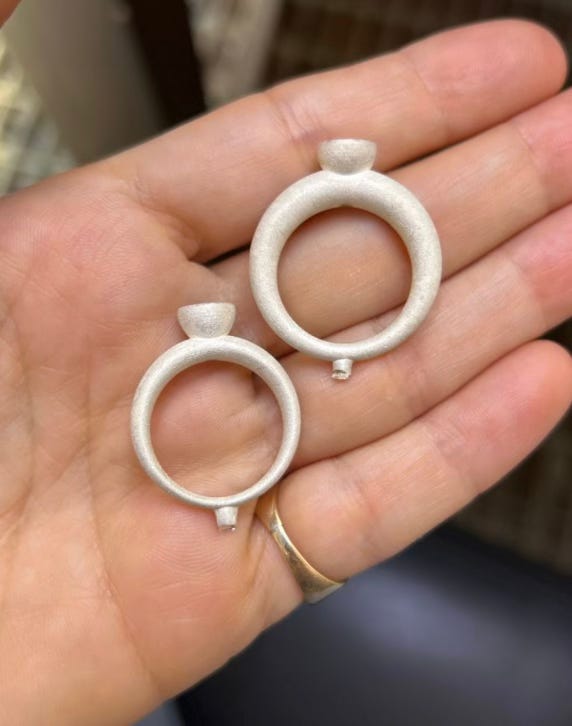
We spent time developing rings incorporating savat, the traditional black silver inlay technique used throughout Ottoman decorative metalwork. Savat requires engraved channels in the metal deep enough to properly hold the darkened compound once it is heated and set into the surface.
In some of our earlier attempts, the engraving was simply too shallow. On paper, the designs looked resolved. But once the savat process began, the material didn’t settle correctly into the lines and the contrast we were searching for disappeared. The pieces felt visually flat, without enough depth or tension between the silver and the darkened inlay. Those rings never made it into production.
At one point I might have seen that as wasted time. Now I understand it differently. Failed attempts force you to look more carefully. To ask better questions. To develop sensitivity towards the material rather than trying to overpower it with concept alone.
You can usually feel when something has been rushed, even if you can’t immediately explain why.
Across most traditional practices, knowledge was never immediate. It moved slowly between generations through observation, repetition, correction. The master-apprentice relationship depended on time. You learnt by watching closely, by doing things incorrectly many times, by remaining near the work long enough for understanding to deepen gradually. There is something deeply humbling in that structure.
Not humility as performance, but humility as a condition of learning.
To remain a student is to remain sensitive. Sensitive to material, nuance, instinct, proportion, timing. Sensitive to the possibility that there is still far more you do not yet understand.
I sometimes think we are losing patience for that kind of depth. We are encouraged to move quickly, to monetise experience prematurely, to position ourselves as experts before we have fully surrendered ourselves to the long and often uncomfortable process of learning. But craft resists shortcuts. The work always reveals where care has or hasn’t been taken.
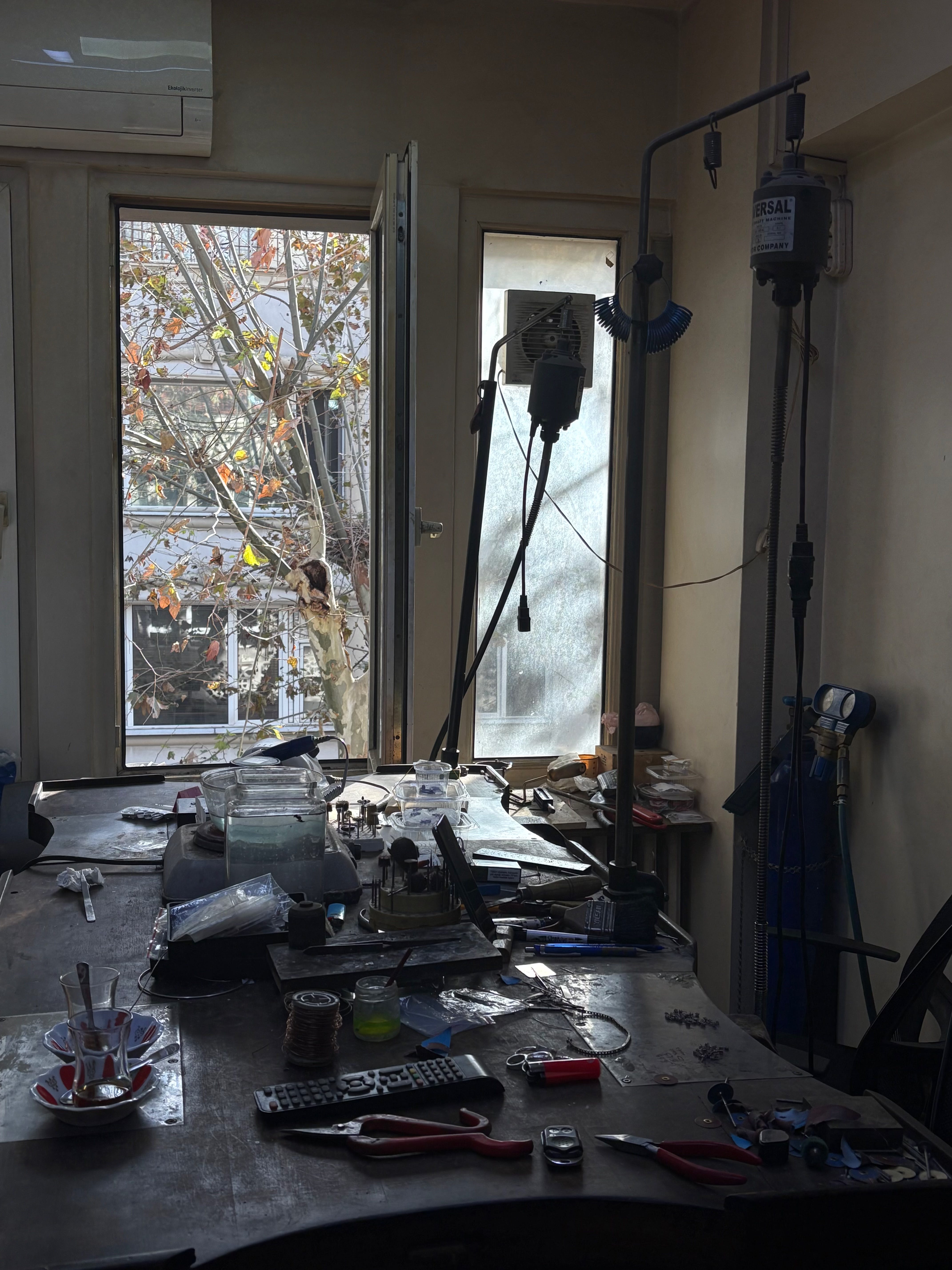
For me, craft has become less about mastery and more about proximity. Staying close enough to the work that it can continue teaching me. Returning to it regardless of what else is happening in my life. Allowing it to sharpen my attention rather than my ego.
Openness is what keeps the work alive.
The discipline now feels increasingly simple, though not necessarily easy. To stay close to the work. To allow for mistakes. To resist the instinct to move too quickly into explanation. To keep learning quietly, long after it would be more comfortable to position yourself as someone who already knows.
Because the moment you decide you have mastered something entirely, you begin to lose your sensitivity to it.
And that sensitivity is where all meaningful work begins.
This is so beautiful Liv. I feel it on so many levels. Thank you for sharing. It’s always been so evident to me how much work goes into every piece. Adore your brain x